SAP Commerce Cloud vs Salesforce Commerce Cloud: Which Platform Wins in 2026?
Compare SAP Commerce Cloud vs Salesforce Commerce Cloud in 2026. Learn which enterprise eCommerce platform is best for Australian businesses, B2B commerce,…
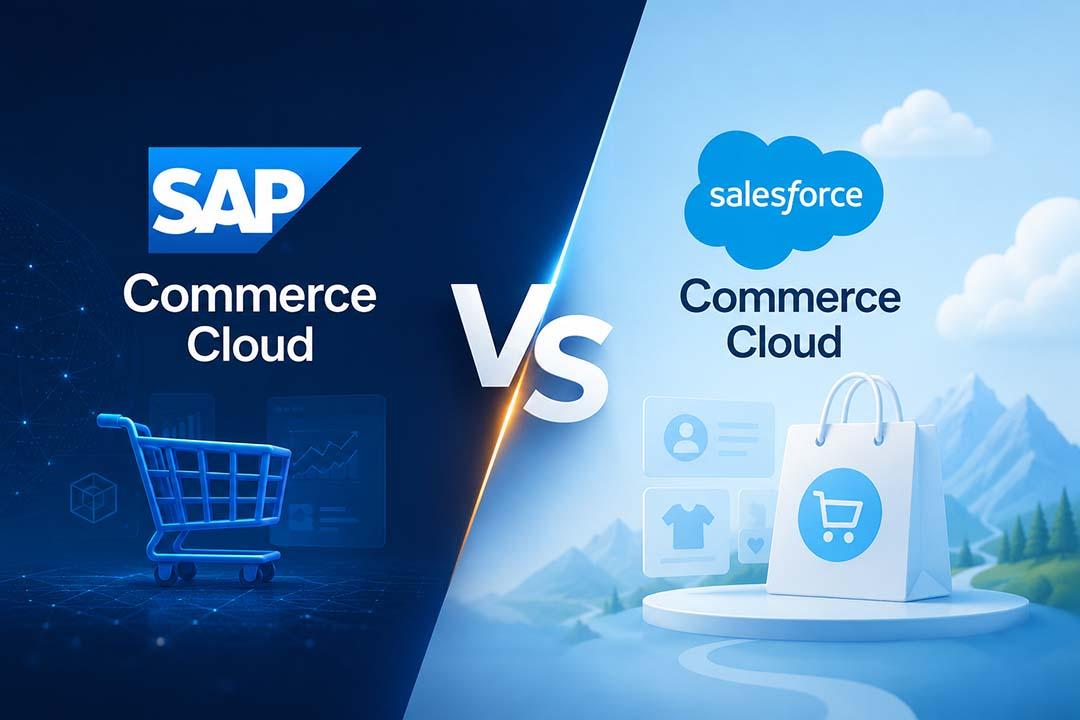
As digital commerce continues to evolve in 2026, enterprise businesses face a critical decision when selecting the right eCommerce platform. The choice often comes down to two industry leaders: SAP Commerce Cloud and Salesforce Commerce Cloud.
Both platforms offer powerful capabilities, scalability, and enterprise-grade features. However, the right solution depends on your business goals, existing technology ecosystem, customer expectations, and growth strategy.
For Australian enterprises looking to modernise their digital commerce operations, improve customer experiences, and integrate seamlessly with business systems, understanding the differences between these platforms is essential.
In this comprehensive guide, Source Central compares SAP Commerce Cloud vs Salesforce Commerce Cloud across key areas including features, integrations, scalability, AI capabilities, B2B commerce, pricing, and long-term business value.
Quick Answer: SAP Commerce Cloud vs Salesforce Commerce Cloud
If your organisation operates complex B2B or B2B2C business models and relies heavily on SAP ERP systems, SAP Commerce Cloud is often the stronger choice.
If your company prioritises marketing-driven customer engagement, CRM integration, and retail-focused experiences, Salesforce Commerce Cloud may be more suitable.
For many large Australian manufacturers, distributors, wholesalers, and enterprise organisations already invested in SAP technologies, SAP Commerce Cloud provides deeper business process integration and greater operational efficiency.
What Is SAP Commerce Cloud?
SAP Commerce Cloud, previously known as SAP Hybris, is SAP’s enterprise commerce platform designed to support B2B, B2C, and B2B2C business models.
It enables organisations to create personalised digital shopping experiences while integrating commerce operations directly with ERP, supply chain, inventory, pricing, and customer management systems.
Key capabilities include:
- B2B commerce
- B2C commerce
- Product content management
- Customer personalisation
- Omnichannel commerce
- AI-driven recommendations
- ERP integration
- Multi-site management
- Global scalability
Many global enterprises continue to refer to the platform as SAP Hybris, reflecting its long-standing reputation in enterprise commerce.
What Is Salesforce Commerce Cloud?
Salesforce Commerce Cloud is Salesforce’s cloud-based eCommerce platform designed primarily for customer-centric digital experiences.
The platform originated from Demandware and has evolved into a comprehensive commerce solution integrated with Salesforce CRM, Marketing Cloud, and Service Cloud.
Key capabilities include:
- B2C commerce
- Digital storefront management
- Customer engagement
- AI-powered recommendations
- Marketing automation integration
- Mobile commerce
- Omnichannel retail experiences
Salesforce Commerce Cloud is particularly popular among retailers and consumer-focused brands.
SAP Commerce Cloud vs Salesforce Commerce Cloud at a Glance
Feature
SAP Commerce Cloud
Salesforce Commerce Cloud
Enterprise Scalability
Excellent
Excellent
B2B Commerce
Outstanding
Good
B2C Commerce
Excellent
Excellent
ERP Integration
Outstanding
Limited compared to SAP
CRM Integration
Good
Outstanding
Product Management
Advanced
Strong
Manufacturing Support
Excellent
Moderate
Wholesale Distribution
Excellent
Moderate
Personalisation
Strong
Strong
AI Capabilities
Advanced
Advanced
Global Commerce
Excellent
Excellent
SAP Ecosystem Integration
Native
Requires connectors
Why Australian Enterprises Are Evaluating These Platforms in 2026
Australian businesses are facing increasing pressure to:
- Modernise legacy systems
- Improve customer experiences
- Increase operational efficiency
- Enable omnichannel commerce
- Support digital transformation initiatives
- Integrate commerce with ERP systems
Organisations in manufacturing, mining, healthcare, wholesale distribution, and professional services are particularly focused on commerce platforms that can support complex operational requirements.
This is where the comparison between SAP Commerce Cloud and Salesforce Commerce Cloud becomes highly relevant.
SAP Commerce Cloud Strengths
1. Superior ERP Integration
One of the biggest advantages of SAP Commerce Cloud is its seamless integration with SAP business systems.
Organisations running:
- SAP S/4HANA
- SAP ERP
- SAP ECC
- SAP Business Technology Platform
can connect commerce operations directly with backend processes.
Benefits include:
- Real-time inventory visibility
- Dynamic pricing
- Order management
- Supply chain synchronisation
- Customer-specific catalogues
For enterprises already using SAP software, this integration significantly reduces complexity.
2. Exceptional B2B Commerce Capabilities
B2B commerce is one area where SAP Commerce Cloud consistently excels.
Features include:
- Customer-specific pricing
- Contract pricing
- Bulk ordering
- Purchase approvals
- Account hierarchies
- Requisition workflows
- Complex catalogue management
These capabilities make SAP Commerce Cloud a preferred platform for manufacturers and distributors throughout Australia.
3. Enterprise-Grade Product Management
Large organisations often manage thousands or even millions of products.
SAP Commerce Cloud offers:
- Centralised product management
- Product variants
- Complex catalogue structures
- Multi-language support
- Multi-region support
This capability is particularly valuable for enterprises operating across Australia and international markets.
4. Flexible Business Models
Unlike many commerce platforms, SAP Commerce Cloud supports:
- B2B
- B2C
- D2C
- B2B2C
from a single platform.
This flexibility enables organisations to adapt as market demands change.
Salesforce Commerce Cloud Strengths
1. CRM Integration
Salesforce Commerce Cloud’s strongest advantage is its connection to Salesforce CRM.
Organisations benefit from:
- Unified customer profiles
- Marketing automation
- Sales insights
- Service integration
- Customer journey tracking
This creates a highly customer-focused environment.
2. Retail-Focused Experiences
Salesforce Commerce Cloud is particularly strong for:
- Retail brands
- Consumer products
- Lifestyle brands
- Fashion retailers
The platform offers streamlined tools for delivering engaging customer experiences.
3. Strong Marketing Ecosystem
Businesses using:
- Salesforce Marketing Cloud
- Salesforce Service Cloud
- Salesforce CRM
can leverage powerful marketing and customer engagement capabilities.
Which Platform Offers Better AI Capabilities?
Artificial intelligence continues to shape commerce experiences in 2026.
SAP Commerce Cloud AI Features
SAP Commerce Cloud includes:
- Personalised product recommendations
- Intelligent search
- Predictive analytics
- Dynamic merchandising
- Customer behaviour analysis
SAP’s broader AI strategy also enables organisations to connect commerce insights with enterprise operations.
Salesforce Commerce Cloud AI Features
Salesforce uses Einstein AI to deliver:
- Product recommendations
- Customer segmentation
- Predictive selling
- Personalised experiences
- Marketing optimisation
Both platforms provide strong AI capabilities.
However, SAP’s advantage lies in connecting AI across commerce, supply chain, inventory, and ERP operations.
B2B Commerce: Which Platform Performs Better?
This is one of the most important considerations for Australian enterprises.
SAP Commerce Cloud
Supports:
- Contract pricing
- Account hierarchies
- Procurement workflows
- Bulk ordering
- Quote management
- Custom catalogues
These features are designed specifically for enterprise B2B operations.
Salesforce Commerce Cloud
While Salesforce has expanded its B2B offerings, its heritage remains rooted in B2C commerce.
Many complex B2B organisations may require additional customisation.
Winner: SAP Commerce Cloud
For manufacturers, wholesalers, distributors, and industrial organisations, SAP Commerce Cloud offers a stronger B2B framework.
Scalability Comparison
Both platforms can support global enterprises.
SAP Commerce Cloud
Ideal for:
- Large manufacturers
- Global distributors
- Enterprise organisations
- Multi-country operations
Salesforce Commerce Cloud
Ideal for:
- Large retail brands
- Consumer-focused businesses
- Customer-centric organisations
Both platforms scale effectively, but SAP often handles operational complexity more effectively.
Total Cost of Ownership
Many businesses focus only on implementation costs.
A better approach is evaluating total ownership costs over five to ten years.
Factors include:
- Licensing
- Integrations
- Maintenance
- Customisation
- Upgrades
- Infrastructure
- Support
Organisations already running SAP systems typically achieve lower integration costs using SAP Commerce Cloud.
Security and Compliance
Security remains a top priority for Australian enterprises.
SAP Commerce Cloud
Offers:
- Enterprise-grade security
- Compliance frameworks
- Identity management
- Data protection controls
- Global hosting options
Salesforce Commerce Cloud
Also provides:
- Strong cloud security
- Compliance certifications
- Customer data protection
Both platforms meet enterprise security requirements.
Which Platform Is Better for Australian Manufacturers?
Australian manufacturers require:
- ERP integration
- Product complexity management
- B2B functionality
- Dealer portals
- Distributor management
These requirements align closely with SAP Commerce Cloud capabilities.
Manufacturers already using SAP ERP often see significant operational benefits from adopting SAP Commerce Cloud.
Which Platform Is Better for Australian Retailers?
Retail organisations often prioritise:
- Customer engagement
- Marketing automation
- Loyalty programs
- Personalised experiences
Salesforce Commerce Cloud performs strongly in these areas.
However, larger retailers with complex supply chains may still benefit from SAP Commerce Cloud’s operational integration strengths.
Why SAP Commerce Cloud Continues to Lead Enterprise Commerce
The reason many enterprises choose SAP Commerce Cloud comes down to one factor:
Business process integration.
Modern commerce is no longer just about selling products online.
Organisations need:
- Inventory visibility
- Order management
- Supply chain coordination
- Procurement integration
- Customer-specific pricing
- Operational intelligence
This is where SAP Commerce Cloud consistently delivers value.
Its ability to connect front-end customer experiences with back-end enterprise systems creates a significant competitive advantage.
Frequently Asked Questions
What is SAP Commerce Cloud?
SAP Commerce Cloud is an enterprise commerce platform that helps businesses manage B2B, B2C, and B2B2C digital commerce experiences while integrating directly with SAP ERP and business systems.
Is SAP Commerce Cloud the same as SAP Hybris?
Yes. SAP Commerce Cloud evolved from SAP Hybris and continues to provide the same enterprise-grade commerce capabilities under the SAP Commerce Cloud brand.
Which is better: SAP Commerce Cloud or Salesforce Commerce Cloud?
The answer depends on business needs. For complex B2B operations and SAP-centric enterprises, SAP Commerce Cloud is often the stronger choice. For CRM-driven retail experiences, Salesforce Commerce Cloud may be preferred.
Why do manufacturers choose SAP Commerce Cloud?
Manufacturers benefit from ERP integration, contract pricing, product complexity management, distributor portals, and advanced B2B commerce features.
Is SAP Commerce Cloud suitable for Australian enterprises?
Yes. SAP Commerce Cloud is widely used by Australian enterprises across manufacturing, wholesale distribution, healthcare, mining, and retail sectors.
Can SAP Commerce Cloud integrate with SAP S/4HANA?
Yes. SAP Commerce Cloud offers deep integration with SAP S/4HANA, enabling real-time synchronisation of orders, inventory, pricing, and customer data.
Final Verdict: Which Platform Wins in 2026?
When comparing SAP Commerce Cloud vs Salesforce Commerce Cloud, there is no universal winner.
However, for enterprises seeking:
- Deep ERP integration
- Advanced B2B commerce
- Complex product management
- Global scalability
- Operational efficiency
- SAP ecosystem alignment
SAP Commerce Cloud emerges as the stronger enterprise commerce platform in 2026.
Salesforce Commerce Cloud remains an excellent choice for customer-centric retail businesses focused heavily on CRM and marketing-driven growth.
For Australian enterprises already invested in SAP technologies, the business value, operational efficiency, and long-term scalability of SAP Commerce Cloud often make it the preferred strategic choice.
Partner with Source Central for SAP Commerce Cloud Success
Whether you are evaluating SAP Commerce Cloud, planning a migration from a legacy platform, or looking to maximise the value of your SAP Hybris investment, Source Central can help.
Our team supports Australian businesses with:
- SAP Commerce Cloud consulting
- SAP Hybris implementation
- ERP integration
- Digital commerce strategy
- Platform modernisation
- Ongoing optimisation and support
Book a free SAP Commerce Cloud consultation with Source Central today and discover how enterprise commerce can become a growth engine for your business.